Fire Alarm Systems
Installed to the current standard IS:3218:2013:NSAI, with a complete professional maintenance service.
Importance of Fire Alarm
The need for a Fire Alarm.
A fire alarm detects a fire at an early stage so as to afford the time needed to evacuate the building quickly and safely while also providing the additional time needed for the Fire Brigade Service to arrive.
A Fire Alarm is a vital “life safety system”, which can be used to also protect your property.
At 365 Fire & Security we install our systems to the most current standard (IS:3218:2013:NSAI) and we also provide a complete professional maintenance service as is required by law.
Often Fire Alarms depend on your building’s “fire certificate” and the system will then be required to be installed on a statutory basis. However for older buildings we can provide you with a complete advisory, design, installation and commission service with the necessary certifications upon completion. 365 Fire & Security staff have been installing commercial systems for over 20 years.
Regulatory Requirements
The current statutory requirements for a fire alarm is set out by the National Standards Authority of Ireland (NSAI), whom define the regulations for the installation of your fire alarm. This statutory regulation is embedded in the 1981 and 2003/2010 “Fire Services Act” which makes this document a legal document and is enforced by a local fire officer.
From its inception in 1989, the standards (Code of Practice) have been previously revised in 2008 and currently is now revised as 2013. The reference to the current standard is IS:3218:2013:NSAI and this standard is available to purchase directly with the NSAI.
Types of Fire Alarm Systems
Conventional
Conventional fire alarms are typically found in small to medium size developments. Conventional systems tend to be cheaper to install than that of Addressable systems. However, they lack the many important features that addressable systems have. A Conventional system will indicate the location of a fire, by indicating on the fire control panel the “Zone” that has activated. This zone may only be named as the “First Floor” with no other detail as to the specific location of the fire. The search area in fact could be as large as 2,000 metres in accordance with the standard.
Addressable
Addressable systems are typically found in larger buildings or developments where locating a fire would be very difficult, so the purpose of an addressable system is to provide the exact location and as much detail as to the seat of the fire. Addressable systems are quite capable of providing the zone name i.e. “First Floor”, the device name i.e. 001, and also the exact device location e.g. Apartment number 15.
Fire Alarm System Categories
There are many types of fire alarm systems each suited to different building types and applications. A fire alarm system can vary dramatically in both price and complexity, from a single panel with a detector and sounder in a small commercial property to an addressable fire alarm system in a multi-occupancy building. Systems have to protect both buildings and occupants. The categories of fire alarm systems are L if they are designed to protect life, P to protect buildings and M if they are manual systems.
M
Manual systems, e.g. hand bells, gongs, etc. These may be purely manual or manual electric, the latter may have call points and sounders. They rely on the occupants of the building discovering the fire and acting to warn others by operating the system. Such systems form the basic requirement for places of employment with no sleeping risk.
P1
The system is installed throughout the building – the objective being to call the fire brigade as early as possible to ensure that any damage caused by fire is minimized. Small low risk areas can be accepted, such as toilets and cupboards less than 1m.
P2
Detection should be provided in parts of the building where the risk of ignition is high and/or the contents are particularly valuable. Category 2 systems provide fire detection in specified parts of the building where there is either high risk or where business disruption must be minimized.
L1
A category L1 system is designed for the protection of life and which has automatic detectors installed throughout all areas of the building (including roof spaces and voids) with the aim of providing the earliest possible warning. A category L1 system is likely to be appropriate for the majority of residential care premises. In practice, detectors should be placed in nearly all spaces and voids. With category L1 systems, the whole of a building is covered apart from minor exceptions.
L2
A category L2 system designed for the protection of life and which has automatic detectors installed in escape routes, rooms adjoining escape routes and high hazard rooms. In a medium sized premises (sleeping no more than ten residents), a category L2 system is ideal. These fire alarm systems are identical to an L3 system but with additional detection in an area where there is a high chance of ignition, e.g. kitchen) or where the risk to people is particularly increased (e.g. sleeping risk).
L3
This category is designed to give early warning to everyone. Detectors should be placed in all escape routes and all rooms that open onto escape routes. Category 3 systems provide more extensive cover than category 4. The objective is to warn the occupants of the building early enough to ensure that all are able to exit the building before escape routes become impassable.
L4
Category 4 systems cover escape routes and circulation areas only. Therefore, detectors will be placed in escape routes, although this may not be suitable depending on the risk assessment or if the size and complexity of a building is increased. Detectors might be sited in other areas of the building, but the objective is to protect the escape route.
Choosing Addressable or Conventional
It is important that when you are designing a fire alarm system that consideration be given to the benefits of an addressable system over that of a conventional system. For example a Conventional system will indicate the location of a fire, by only indicating on the panel the “Zone” that has activated. Whereas for example, an Addressable system will indicate the exact location and exact device that has activated.
This will allow the Fire Brigade to be able to locate the fire at this location immediately upon arrival as opposed to the approximate location of the fire indicated on a conventional system. Of course if the system is a small development or building, the need for such an addressable system is not warranted as a conventional system will be satisfactory in this case. If unsure as to the most appropriate system we at 365 Fire & Security can advise you of which system is suitable for your needs.
Another benefit of an Addressable system over that of a Conventional system is the ability to trace any faults that may arise, specifically faults that arise from tampering. For example: if a detector in an Apartment is tampered with this will be indicated on the fire panel as to the exact location the tampering took place, so just that Apartment needs to be accessed. Whereas with a conventional system, everywhere on that zone needs to be checked and accessed to trace that fault.
Addressable systems also tend to require less cabling to be installed meaning installations can be completed in less time and in a tidy manner.
Disabled Refuge Systems
Disabled refuge systems are essentially a professional intercom system that allows a disabled person to raise awareness to the Fire Brigade service, typically at the main Entrance Lobby of the Building, that they are located on a particular stairwell landing awaiting rescue.
These systems are generally installed on each landing that has a dedicated refuge location, for a disabled person to hold up until they are rescued. This is important as the Fire Alarm will ordinarily disable the lifts preventing a wheelchair user from escape. These systems are becoming more common place and 365 Fire & Security has been installing such systems for over 20 years and provides a full maintenance arrangement to existing systems.
Disabled Toilet Alarms
Disabled toilet alarms are a very simple means of raising the attention of either Reception personnel or a Security office, should a disabled person using the facilities find themselves in difficulty and require assistance.
These systems are intended to raise a local alarm by way of a buzzer and a flashing light over the door of the disabled toilet, while at the same time a local buzzer will activate in Reception or Security. The system is a standalone system and is simply activated by either a pull chord or a press button in the toilet. The system can be simply “reset” i.e. silenced by pressing a button either in Reception or Security or at the toilet itself. If there are more than one disabled toilet, 365 Fire & Security can advise you of a system that incorporates all the alarms in one panel.
Devices
Manual Call Point
Manual call points are a means of raising a fire alarm manually. They are often referred to by similar terms such as fire break glasses or fire call points. The fire alarm standards require that in every circumstance when a manual call point is activated, it must create a full fire alarm event.
Modern manual call points are now designed to be resettable, whereby older buttons required the glass to be replaced when activated. Covers are available for the units and can be placed over the manual call point to prevent accidental activation. This then requires the lifting of the cover first followed by the pressing of the button. In practice this dramatically reduces false alarms.
Two manual call points exist, as illustrated. The red call point this is for fire alarms, whereby the green call point is in fact for the manual releasing of locked doors (access controlled for example) in an emergency. In most cases a key is required to reset any call point after its activation.
Detectors
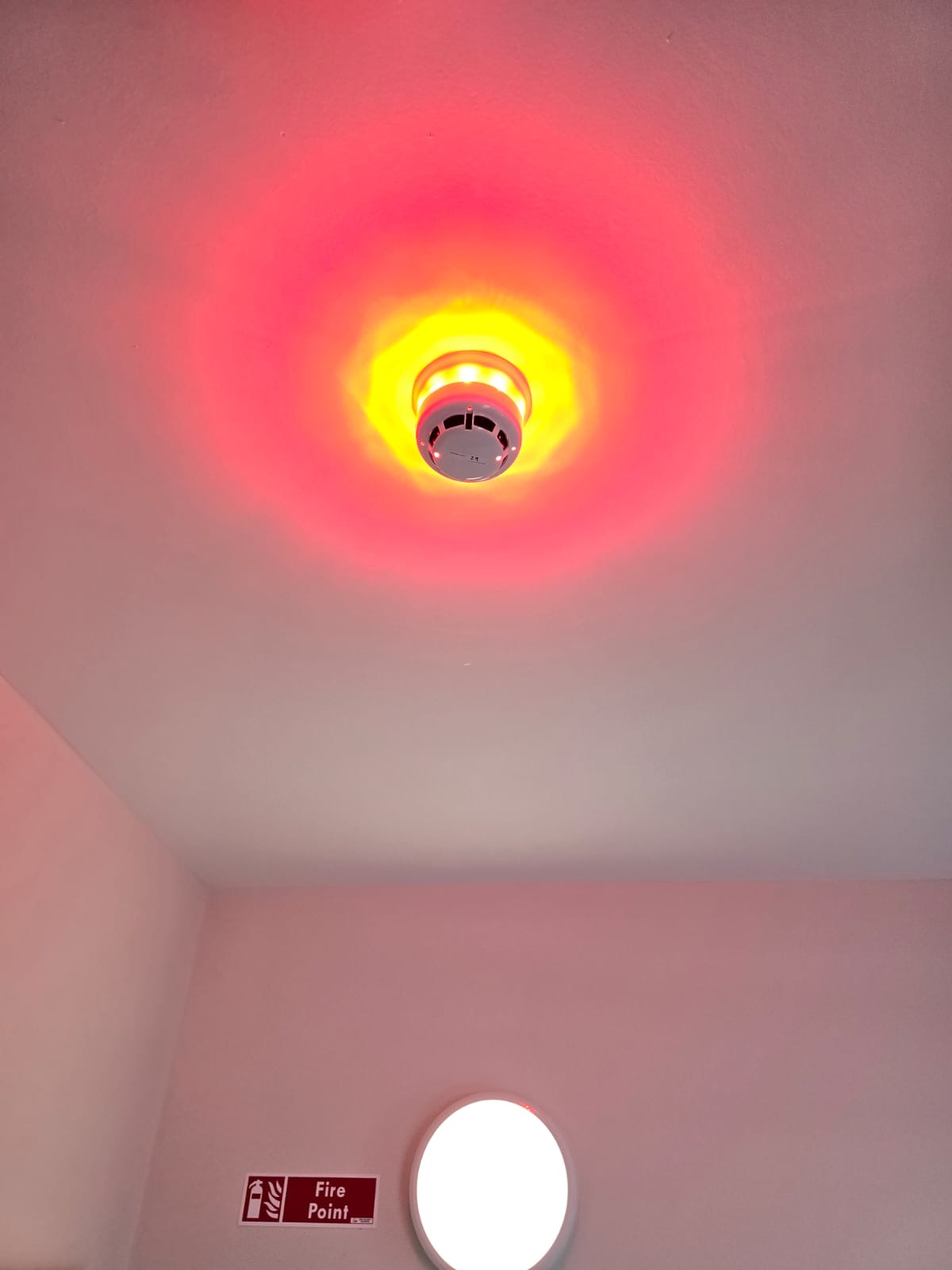
Detectors form the most important part about any Fire Alarm system. Detectors are used to automatically raise an alarm and to give the necessary time to evacuate safely in the event of an emergency. It is vital that the correct choice of detector is made for a given location whilst also considering the nature of the fire expected.
Fires range from “fast and flaming” to “slow and smouldering”. The detectors required for detection of these type of fires differ greatly. It is essential in the design of the system that the correct detector be installed.
Types of detectors typically range between smoke or heat detectors (these being the most common). Each device has characteristics that must be considered. In certain instances combined detection will be required. Furthermore, addressable smoke detectors are only compatible with addressable fire systems and likewise conventional smoke detectors operate only with conventional systems.
Sounders and Strobes
Fire alarm sounders are the only means with which to raise the alarm in the event of fire. These sounders are manufactured in many shapes/types (wall, ceiling, base mounted etc), and can have various output sound levels. There are fire alarm sounders that also combine a strobe light to give a visual indication of a fire for persons whom maybe hard of hearing.
You would also expect fire alarm sounders with a strobe light for example in noisy warehouse(s) or a theatre. I note that the installation of sounders must adhere to the strict sound pressure levels as laid out in the Fire Alarm code of practice (IS:3218:2013:NSAI).
It is recommended (when designing) apart from achieving the sound pressure level (measured in dB), that the sounders should be installed so that there are numerous sounders using a lower volume than that of fewer sounders with a louder volume, which may cause disorientation for an elderly person trying to evacuate.
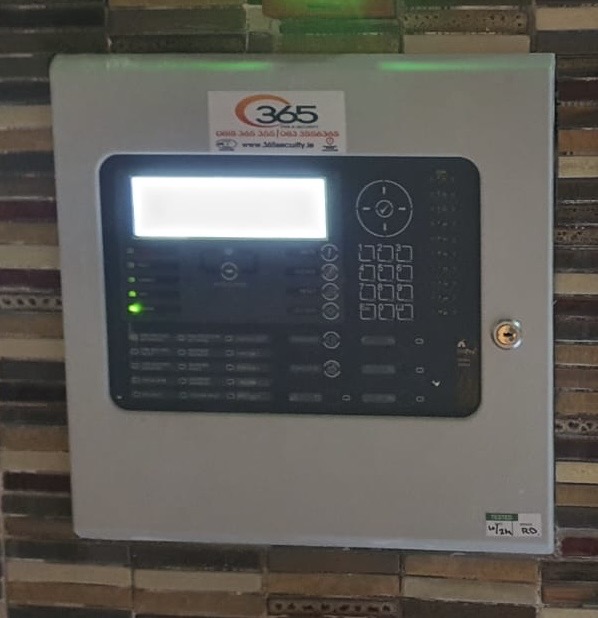
Control Panels
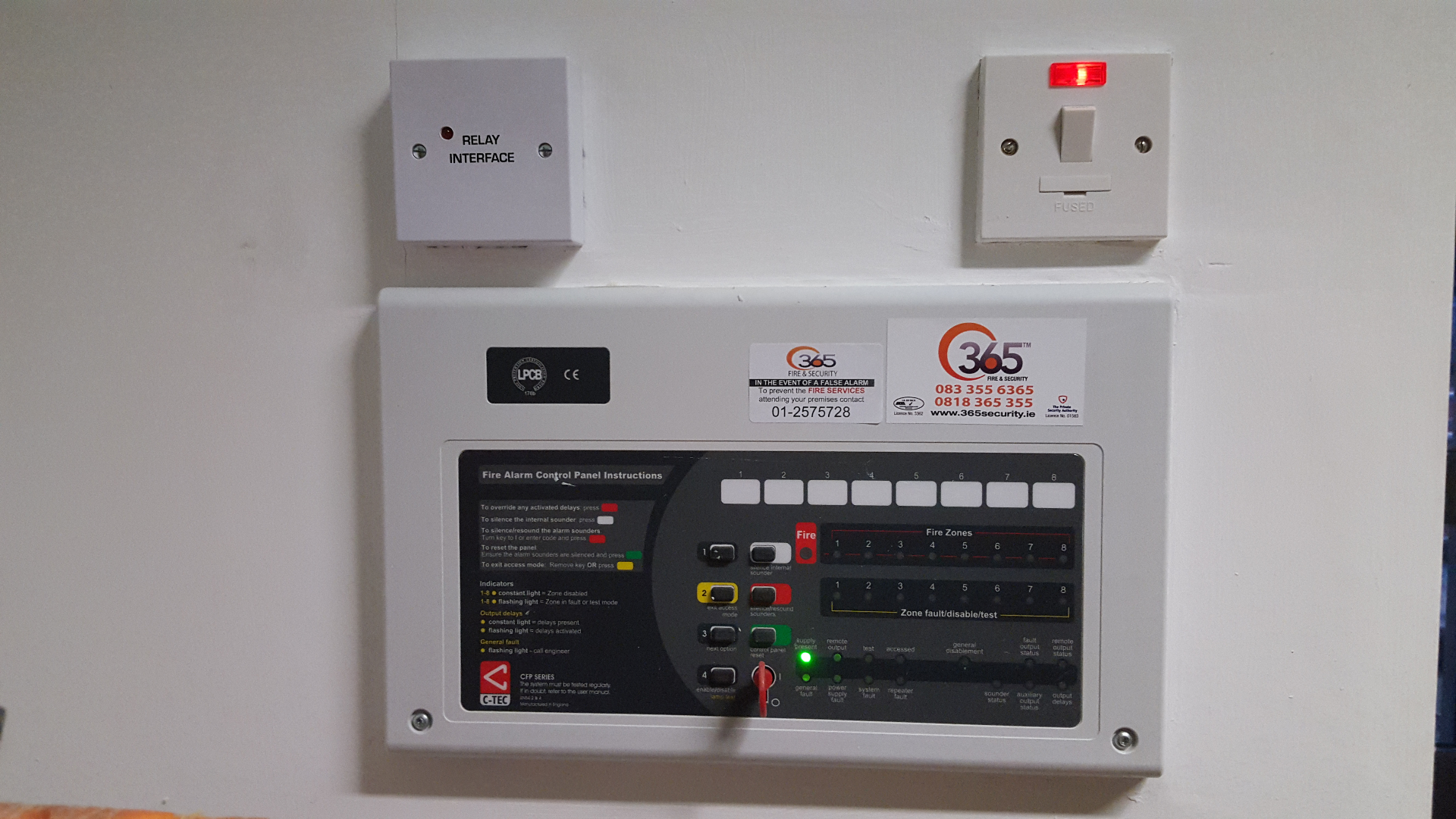
Fire alarm control panels are available from several Manufacturers but there are mainly two types of system;
- A “Conventional type system” or
- An “Addressable type system”.
At 365 Fire & Security, we generally use the manufacturers “C-tec”, “Morley” and Advanced for our installations, all of whom offer various conventional and addressable options. We have found these Manufacturers to provide the best quality of product with a large after sales service, and all have an expert technical support network in place. These particular manufacturers have a significant presence in the Irish fire alarm market and come well recommended.
Maintenance
Regulatory Requirements
Fire alarm systems are required by law (Statutory requirement) to have a preventive maintenance contract in place. The current Irish fire alarm standard (IS:3218:2013:NSAI) requires a building with greater than 20 devices/smoke detectors with persons residing to be tested “quarterly” and the necessary servicing documentation completed.
365 Fire & Security has been maintaining Fire Alarm systems since 2005 and has a full professional dedicated servicing and Maintenance team. 365 Fire & Security currently provides professional servicing and Maintenance to many Property Maintenance Companies, Office Buildings, Schools, Retail Sector and Apartment Blocks.
We are a highly experienced professional company in respect of the maintaining of both Conventional and Addressable fire alarm systems. 365 Fire & Security has a dedicated Service Team whose job it is solely to look after all fire alarm systems under our care. 365 Fire & Security can look after all types of installed fire alarms, even if not originally installed by ourselves. Should you wish to consider 365 Fire & Security to offer a preventative maintenance contract, we would be happy to call to you to survey or audit all aspects of your fire alarm system and to provide you with a professional competitive quotation or professional assessment as to the condition of the current system.